KingsTreeWestendValleyBleaklowStonesBarrowDerwentSlipperyStonesKingsTree
12 th December 2008
A Great Way onto Bleaklow
Who went: Self, PNO gone to Lincoln, DG in Poland, PH put off by weather, others working
Weather: Low cloud down to 800ft but at the end of the day it was so low you couldn't see the far side of the Dams. Cold. Snow under foot. Frozen above 1500ft but slushy all the way down the Derwent Valley
Parking: Park at Kings Tree. It's free as long as you go on a weekday. Access is limited at weekends and at Bank holidays.
Had intended to ascend Bleaklow and walk round the plateau edge but the cloud was low and it would have meant another hour plus of route finding, which in view of the weather, visibility and time of the year would have made it difficult to get down by sunset – if there had been any sun.
The Walk
There was snow on the road all the way up to Fairholmes but past here the wood cover ensured the roads were clear. But as soon as I got out of the car I realised the roads were not as easy as I had thought. They were covered in black ice. Good job I took it easy on the journey to the Tree.
From the lay by on the dam side of the road just before the tree – planted by King George VI after the Second World War – walk back down the valley road. Care was needed as the road was covered in ice and where streams crossed the road there was a thick coating of ice. This was especially so on the first part of the journey down the road where there is a lot of tree cover over the road. Progress, consequently, was slower than normal; which was a portent for the day. Usually it is rain and the associated mud or peat mire that slows you down; today it was the cold, making conditions underfoot unpredictable – slushy at lower levels and icy on the tops. At Windy Corner the tree cover over the road is less and the going improved on the walk down into the Westend valley. The vista looking across or back down the valley changes with the seasons. Today there was a light covering of snow and a breeze so no reflections in the dam water. The tops were covered in cloud, making it rather an eerie place. There were no people and no cars and the wildlife was muted. Because of the icy road I walked on the grassy edge – much easier.
As the waters of the dam arm stops the road crosses the feeder river – the Westend - on a typical stone bridge. Just before the bridge turn right through a pedestrian gate by a 5 bar gate onto a forest track. In 30m turn left and cross a bridge over the Westend and walk up to a T junction. Turn right on a good track that takes you through the wooded bottom end of the Westend Valley. It is always peaceful here and one of the most enjoyable walks out of the Derwent Valley no matter what season. Today it was cold and the puddles on the track were frozen. There was some snow.
The track follows the left hand bank (southern) of the river, which constantly gurgles and bubbles breaking the quiet.
After 0.75km turn right and cross the river using a bridge; it's a footbridge with a bird box hanging from the bridge . The path then follows the right hand bank for 100m before hitting a track – the shooting track that fords the river just above the bridge. Turn right on the track, which climbs and then tracks the bottom of a wood and along the valley side 30m or so above the river. After 0.6km you leave the wood behind and in another 200m the track begins to climb away from the river.
Here go straight, turning left off the track and drop down to a stile which crosses a fence on the bank of the river. From here a path tracks the right hand bank of the river and the real Westend valley starts to be exposed.
As you walk down the valley shortly you cross another fence via a stile. On the opposite bank were the bodies of two dead sheep; wonder why/how they died? 400m after leaving the track you cross Grinah Grain, a deepish valley on our right; the path continues ahead leading up the valley. After crossing the Grinah Grain you have two options. Take the right hand path which climbs up 30m or so; note the left hand path tracks the river bank but dwindles out after the next clough on the left - Raven Clough.
The path stays above the left hand bank of the river as you walk up a magnificent desolate valley.
There are some interesting geological features around Raven Clough which are clearly the remnants of a previous water course of the river. Gradually the path drops down to river as it crosses Deep Grain – a Clough going off to your right. By now visibility ahead was down to 100m.
After crossing Deep Grain keep straight and shortly before the remains of a walled area that use to house a rain gauge, the valley divides. Take the left hand clough and in 150m the way ahead divides again.
By now the valley sides are quite steep and the area is quite claustrophobic. Take the left hand clough and climb up the right hand side. It was not easy going with small snow drifts. If you put your foot in the wrong place you could sink up to your knee, and into water! The gradient for the next 0.5km is at its steepest and no matter how fit I am this type of terrain always seems to take it out of me. I think it's because you can't get into a rhythm because the path is indistinct. Eventually the gradient lessens and you come out of the steepest part of the clough at the junction with another coming from the right. Carry on straight; you are now on Westend Head. Visibility was down to around 50m.
In a couple of 100m another clough goes off to the right, followed by a second with a clough off to the left.
Take the first of these cloughs; you walk up Westend Head on the final ascent onto the Bleaklow Plateau; about 300m east of The Ridge, a clear landmark on a clear day.
The gradient is not difficult and the clough soon becomes wide and shallow. Up this clough I followed a white hare for about 200m. As I got to within 10metres of it, it hopped off into the distance; a pleasant friendly gesture in an hostile environment. Although the ground was by now frozen and you could walk over the drifts without sinking up to your knees, it was still slow going, perhaps because I hadn't walked in snow for some time. There is clearly a technique to walking on the snow which is different to walking of peat moors or muddy limestone paths. Still it was good fun as another grand happening was about to occur.
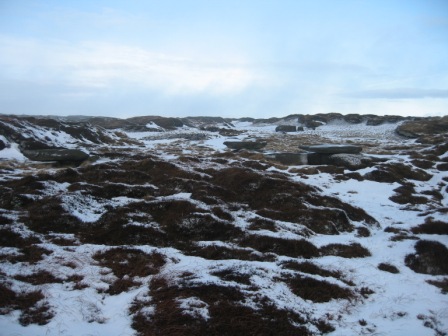
As I climbed up the clough, the grey cloud thinned and then blue sky. The view was fantastic, looking back down the valley with The Ridge and the path up from Alport clearly visible on the right. The scene was like a desolate sand dunned area with snow covered peat groughs taking the place of sand. It is a site that every fell walker needs to witness, so don't be put off and choose a clear day after snow; you wouldn't have to wait too long , especially if you are retired!
As the gradient lessens the distinct form of Bleaklow Stones can be seen up to the right. Continue up the clough until you hit the shallow stones that mark the edge of the plateau. You should also see a wooden post that marks the fence that traverses east/west this part of the Bleaklow plateau; it is a well trodden route and you should be able to see tracks in the peat moors. If the weather is down then as the gradient flattens, you hit some stones which leads into the plateau and peat groughs. Here turn right (east) and walk 250m to the eastern edge of the Bleaklow plateau and The Stones. The Stones have some unusual shapes and we should have a competition naming some a la the Kissing Stone of Wain Stones.
Today the view from Bleaklow Stones was great but short lived. North you could see Home Moss and Black Hill in brilliant sunshine while the way ahead, to Barrow and Grinah Stones, was like a ‘snow desert'. But suddenly the cloud came down and the views were gone for the day. But it was worth it all the same.
With the cloud down, care is needed over the path to Grinah Stones, especially if like me you are the first over the ground after snow. Snow always makes path finding more difficult and it's easy to take the wrong ‘path'; you have been warned. From Bleaklow Stones the path heads round the top of Deep Grain, descending off the plateau and heading in a direction just north of east. There are two or three path options but take the widest and most obvious, which is the second from the right. This drops around 80m, slowly bending southerly until it crosses the distinct clough of Deep Grain. As you drop be aware that the temperature rises and the state of the ground changes. I went through the snow crust and my foot ended in a watery peat stream; old heads sometimes don't know best. Once you've crossed Deep Grain the path climbs up to Grinah Stones. From afar these Stones look very distinct. When you climb up to them on this path or from Barrow Stones you get no idea of their presence. Still today you couldn't appreciate them no matter where you were viewing them from.
Walk to the southern end of Grinah and from here a path goes off just east of north tracking the edge of the moor towards Crown Stones and onwards to Barrow Stones. The views from Grinah are worth the effort; on a bad day you could be anywhere.
From Grinah the next target is Crown Stones and onwards to Barrow Stones on a good path heading just east of north.
After 0.5km you hit Crown Stones – on a clear day you can see the distinct rock formations of the southern part Barrow Stones known as Crown Stones having just left Grinah Stones; to their right is a gate in a fence from which a path leads to Round Hill and down Ridgewalk Moor. From the top of these Stones (left-hand side) a path continues north to a further set of Stones that marks the northern part of Barrow Stones.
Below Barrow Stones, to the north is the upper reaches of the Derwent valley (if you can see it).
From here, head North East and begin the descent into the Derwent Valley. In 20/30m you have to clamber across a fence – there is no gate but the fence isn't high and for the average sized man (sorry ladies for the chauvinism) it's an easy traverse. The aim is to drop down and cross the Derwent just above its Junction with Barrow Clough. After crossing the fence I picked up a grough that was easy to follow down to some large boulders; somebody ascended this way earlier but when I got to the boulders I lost the tracks. From the boulders, keep heading north east. The gradient drops more sharply; as I dropped down I started coming out of the cloud and the temperature rose. In misty conditions you have to be careful because perspective becomes distorted and things look flat; or they do to me. It was only when I was below the cloud level that I clearly understood where I was. The other factor is that the temperature rises and the going underfoot becomes more difficult. No longer can you walk on drifts without going up to your knees or worse – see earlier.
As you drop towards the River Derwent there are clear ‘paths' that people have used to ascend Barrow Stones from the river. Pick one of these and follow the route down to the river. The nearer the river you get the wetter the ground becomes underfoot – so beware.
Cross the river and follow the bank until you are about opposite Barrow Clough; you should then be able to pick out a path that climbs away from the Derwent, heading for Hoar Clough. Once Hoar Clough is crossed the path is quite clear, if wet and boggy.
The path follows the line of the river for 0.5km to Coldwell Clough then continues by the river bank for 0.4km to Humber Knolls before climbing up and away from the river. Don't be tempted to climb away too early; it's clear when you need to climb away as there is no clear path by the river – obvious, of course it is when you know where you are!
The going is now quite straight forward, as the path rapidly turns into a track some 50m above the river, which is below you on your right. It's usually a quick descent, but in these conditions with water on top of ice the going was slower.
After 1.3km of descent the track crosses the bottom of Stainery Clough, before crossing Broadhead Clough a further 0.75km down the track. By now you can see the forest ahead, that marks the end of Howden Reservoir. In a further 0.75km you hit Cranberry Clough and a path joins from the left descending from Cut Gate End.
Cross the small footbridge across the bottom of Cranberry Clough and ahead take the right hand path that takes you to the bridge at Slippery Stones.
Cross the bridge and climb up to the gate that gives access to a track that leads you through woods to the end of the dam and the road at Kings Tree.
Just as I passed Linch Clough a couple with a small baby in a sling came towards me; by the time I'd got to the car and taken off my boots they were back in their car – the only other one parked. It was cold and miserable as the cloud was down and it was difficult to see the far side of the dam. The road that had been frozen in the morning was now wet and not slippery but it was only 1C. As I drove back down the valley road, the mist came down and you certainly couldn't see the far side. Howden Dam looked eerie as you see the near dam wall and tower but the water was going over the top of the main dam wall and you couldn't see the far tower. It looked like the sea side with a fret down. Weird.
Summary
A grand walk with a good approach to Bleaklow – the best so far. Saw no one out on the moors, except for one fresh set of foot prints near Barrow Stones. There were a couple of friendly white mountain hares and much low cloud. The highlight occurred when the cloud lifted just before I got to the high point at Bleaklow Stones.
Route finding is straight forward until you get to the top part of the Westend Valley. Here there are no paths onto Bleaklow or across the plateau to the Stones. From Bleaklow Stones the route is clear to Barrow Stones but then generally pathless down to the River Derwent. Once you hit the river there is a good path/track back to Kings Tree.
Home Start Point PeakDistrict Books Related Sites TextOnly Map&Summary
Home Start Point PeakDistrict Books Related Sites TextOnly Map&Summary